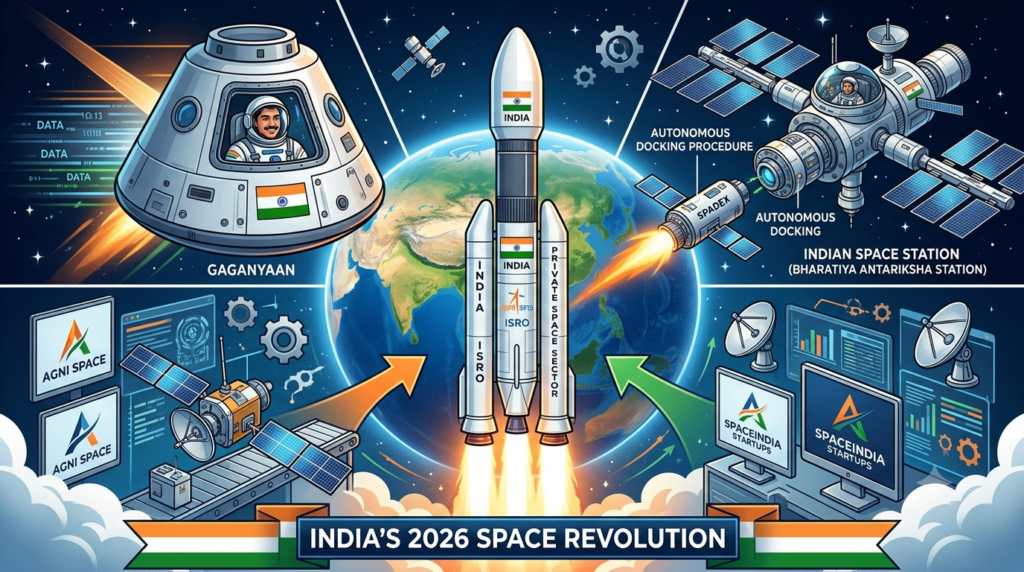
If you grew up in India, the Indian Space Research Organisation (ISRO) has always been a source of quiet, unshakable national pride. We watched the Mangalyaan mission succeed on a shoestring budget, and we collectively held our breath during the Chandrayaan lunar landings. But if you haven’t been paying close attention over the last couple of years, you might have missed a monumental shift.
As we navigate through 2026, the Indian space sector isn’t just about launching satellites on reliable rockets anymore. It has fundamentally transformed into a high-octane, multi-layered ecosystem. From sending our own astronauts into orbit to handing over the keys of launch vehicles to private startups, the current era of Indian space exploration feels less like a government program and more like a sci-fi blockbuster coming to life.
1. The Human Element: Gaganyaan Gets Real
For years, the Gaganyaan mission—India’s indigenous human spaceflight program—felt like a distant dream. But right now, it is undeniably tangible. We are no longer just building the hardware; we are actively preparing the people.
A massive milestone was crossed recently when Indian astronaut Group Captain Shubhanshu Shukla boarded the International Space Station (ISS) as part of the Axiom-4 mission. He didn’t just go up for the view; he conducted seven microgravity experiments, providing ISRO with crucial insights into crewed mission coordination and emergency response.
Back home, ISRO is in the final prep stages. After successfully demonstrating the Crew Escape System, the program has been expanded to include eight preparatory missions—including three uncrewed flights—to ensure absolute safety before the final crewed launch, which remains targeted for early 2027. Once that happens, India will officially become only the fourth country in the world to independently send humans into space.
2. Docking in the Void: The SPADEX Triumph
One of the most mind-bending achievements of this era doesn’t involve astronauts at all. It involves two machines meeting in the absolute emptiness of space.
Through the SPADEX mission, ISRO successfully demonstrated autonomous docking, undocking, and even power transfer between two satellites in orbit. If you’ve ever tried to parallel park a car in a tight spot, imagine doing it with two objects traveling at thousands of miles per hour in a zero-gravity vacuum. This incredibly complex maneuver made India only the fourth nation to demonstrate space docking capabilities.
Why does this matter? Because docking is the foundational technology for building space stations, refueling satellites, and executing deep-space inter-planetary missions. It is the architectural difference between just visiting space and actually setting up camp there.
3. Passing the Baton: The Private Sector Explosion
Perhaps the most significant cultural shift in Indian space research is the deliberate dismantling of ISRO’s monopoly. The government has realized that to capture a larger slice of the global space economy, ISRO cannot do everything alone.
Enter the private sector. Through initiatives driven by IN-SPACe, we are seeing a massive technology transfer. ISRO is literally handing over the blueprints of the Small Satellite Launch Vehicle (SSLV) to a private Indian industry consortium. Startups are no longer just building small components; they are running experiments on ISRO’s POEM-04 orbital module and planning their own lunar exploration missions. The ecosystem is vibrant, heavily funded, and fiercely competitive.
4. NISAR: The Ultimate Earth Observer
While we are looking outward, we are also building better tools to look back at ourselves. In July 2025, the GSLV-F16 successfully launched NISAR—the first-ever joint Earth-observation mission between ISRO and NASA.
This isn’t just an ordinary satellite. It carries one of the most expensive and advanced radar payloads ever built, featuring a massive 12-meter unfurlable antenna. Now fully operational, NISAR is scanning the globe, providing incredibly detailed data on ice-sheet collapses, agricultural shifts, and tectonic movements. It is a testament to what international scientific collaboration can achieve.
The Road to 2035
When you look at all these pieces together—the astronaut training, the orbital docking, the private sector boom, and the heavy-lift rockets—a very clear, ambitious picture emerges. Gaganyaan isn’t the finish line; it is just the warm-up act.
Every single hot test of a cryogenic engine and every line of code written by a space startup is leading toward a singular, audacious goal: the establishment of the Bharatiya Antariksha Station by 2035. The Indian space narrative has officially shifted. We are no longer just proving that we can reach space; we are actively deciding what we want to build once we get there.