1. Legislative Updates & Judicial Appointments
Increase in Supreme Court Judges
- On August 3, 2026, the Lok Sabha passed the Supreme Court (Number of Judges) Amendment Bill without debate.
- The legislation replaces a previous ordinance and increases the sanctioned strength of the Supreme Court from 34 to 38 judges, including the Chief Justice of India.
- The government stated this expansion is essential to address a mounting backlog, noting that 92,101 cases were pending before the apex court as of January 1.
- The additional judges will also allow the Chief Justice to constitute Constitution Benches more consistently.
Modernizing Digital Evidence Laws
- The Bankers’ Books Evidence Bill, 2026, was recently introduced in Parliament.
- This bill seeks to repeal a colonial-era 1891 law to officially recognize digital, electronic, virtual, and cloud-based banking records as admissible evidence in Indian courts.
- It also establishes frameworks for the digital authentication of financial records.
2. Artificial Intelligence in Legal Practice
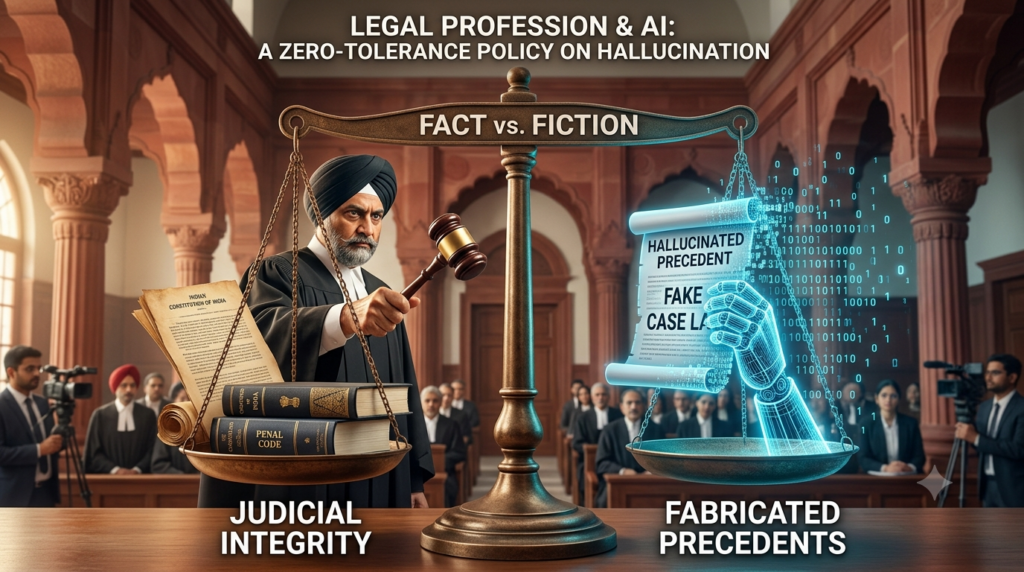
Supreme Court Strikes Down AI-Hallucinated Precedents
- In a landmark ruling on July 2, 2026 (Pooja Ramesh Singh v. Jammu & Kashmir Bank Ltd.), the Supreme Court set aside an order by the National Company Law Tribunal (NCLT) after discovering the tribunal had relied on non-existent, AI-generated case laws.
- A Bench of Justices P.S. Narasimha and Alok Aradhe warned that relying on fabricated AI precedents “subverts the rule of law” and is “catastrophic” to the judicial process.
- The Court declared a “zero-tolerance” policy for producing or citing AI-generated precedents without independent verification, stating that doing so amounts to professional misconduct for advocates.
- The Bar Council of India (BCI) has been directed to form a committee to examine this growing issue, frame guiding principles, and prescribe disciplinary actions for lawyers who violate these norms.
- Prior to the above ruling, the Supreme Court’s AI Committee released the “Draft Regulations for Use of Artificial Intelligence in Courts, 2026” for public consultation.
- The framework allows lawyers and litigants to deploy AI for tasks such as legal research, translation, drafting assistance, and case management.
- However, the regulations mandate strict disclosure: any party using AI for pleadings or evidence must inform the court at the time of filing.
- The draft explicitly bars AI systems from deciding cases, evaluating witness credibility, or determining bail and sentences. If an AI-generated filing contains fabricated or inaccurate material, the lawyer or litigant remains fully accountable and cannot use the AI’s error as a defense.
- The Supreme Court has firmly reinforced pedestrian rights, directing the Centre on August 3, 2026, to ensure that all roads have properly demarcated, encroachment-free spaces for walking.
- The Bench instructed authorities to separate walking spaces from motor vehicle lanes without needing massive construction investments, suggesting simple demarcations like ropes if necessary.
- This follows a significant verdict from June 19, where the top court ruled that the right to walk on a demarcated footpath is a fundamental right under Article 19(1)(d) (right to movement) and Article 21 (right to life and liberty) of the Constitution.