Mental health on campus after the recent IIT incidents: What actually helps (and what doesn’t). Real resources, how to use campus counsellors, and when AI chatbots are useful vs risky.
Campus mental health after the latest IIT deaths is not a “awareness week” problem. It is a daily mix of academic load, isolation, delayed help, and systems that still react after a crisis instead of catching students before they fall. IIT Delhi’s latest case — MSc Physics student Rishikesh Kumar in August 2026 — is the eighth student death by suicide on that campus since 2023 and part of a wider pattern: alumni trackers counted 65 IIT student suicides between 2021 and 2025.
Protests followed because students say the gap is not only “more counsellors on paper.” It is whether a struggling student can get help tonight, whether a faculty member notices early, and whether the institute treats distress as a systems issue instead of a private failure.
Here is what the evidence from campuses actually shows — what moves the needle, what does not, how to use campus counsellors in practice, and where AI chatbots help versus where they become risky.
What actually helps
Collective, boring, repeated contact beats one more committee. IIT Madras has reported no student suicides since April 2023 after it treated wellness as shared work, not a wellness-centre-only job. Faculty are assigned small groups of students and expected to meet them regularly (including meals). They report if someone looks off. Counsellors increased sharply (from a handful to well over a dozen). Staff across hostels and services get trained. Parents can stay on campus in serious cases. Students can attend online if they need to go home. Stigma drops when counsellors show up in hostels and libraries instead of waiting behind a closed door.
Other measures that show up again and again in places trying to get this right:
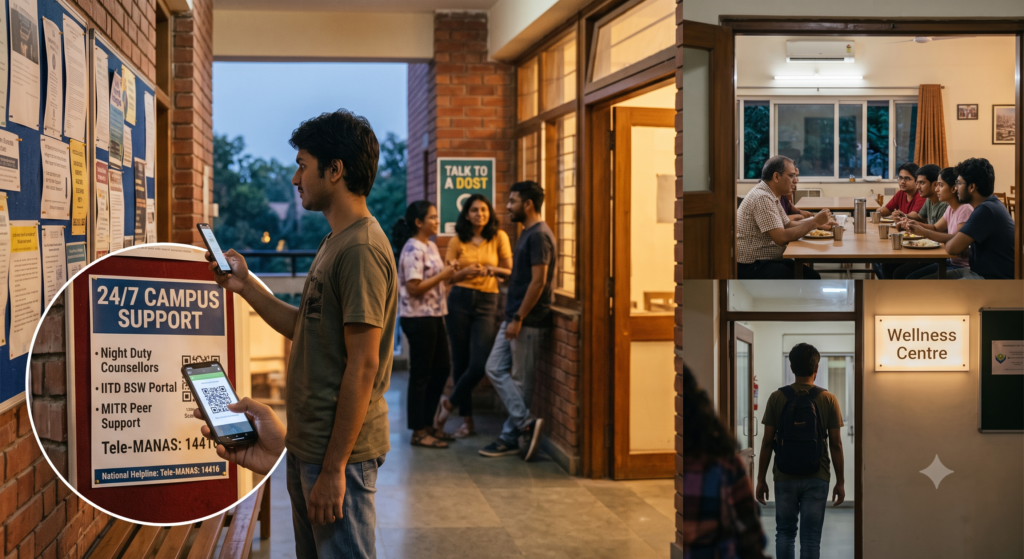
- 24/7 access that is physical, not just a poster. Night-shift counsellors in hostels (IIT Delhi lists live night duty numbers on its BSW mental-health portal). Mobile counsellors who walk hostels instead of waiting for walk-ins. QR codes on room doors that open a helpline or booking page.
- Academic relief that is real. Smaller first-year batches, fewer weekend exams, ability to drop a course, removal of rigid minimum-CGPA walls for the degree, evening tutoring for backlogs, option to pause without disappearing from the system. Pressure plus no exit ramp is a known combination in several inquiry notes.
- Peer layer that is trained, not just “talk to your wingie.” Buddy programmes (UG, PG, international), MITR-style listener networks, “Talk to a Dost” buttons. Peers catch isolation first; professionals handle what peers cannot.
- Early, low-stigma screening for freshers plus follow-up that is not optional when risk is flagged (IIT Kanpur moved this way after clustered deaths).
- Grievance paths that close the loop. A tracked ERP ticket, SC/ST and OBC cells that actually act, an ombudsperson when internal channels stall. Delayed housing, project rejection, or supervisor conflict shows up in multiple recent cases; “we have a cell” is not the same as a time-bound answer.
- Reimbursed external care. When campus slots are full, IIT Delhi and others reimburse AIIMS/VIMHANS or partner hospital consults so students are not stuck waiting.
Supreme Court guidelines (2025) and UGC draft norms now push a counsellor-to-student ratio, mandatory staff training twice a year, no public shaming by batch, visible Tele-MANAS numbers, and written crisis protocols. Implementation is still uneven. The campuses that improved outcomes treated these as operating procedures, not compliance PDFs.
What does not help (even when it looks like action)
Committees announced after every death, without changing faculty load, hostel night cover, or academic flexibility. Counsellor numbers that stay far below need — many HEIs still have no full-time professional; surveys have found large shares of institutions with no easy access at all.
Telling students “just reach out” while they fear the session will leak to a supervisor, affect a recommendation, or get written into an academic file. Isolation plus language, caste, or money-based othering inside hostels. Treating every death as a unique personal tragedy instead of asking which process failed (project allocation, leave, parental contact, night response). Ceiling-fan removal and rooftop locks are harm-reduction; they are not a mental-health programme.
Awareness talks without a next step at 2 a.m. also fail. Students already know the slogan. They need a number that answers and a human who can book the next session.
How to use campus counsellors (practical, not brochure)
Campus counselling is free and meant to be confidential. Confidential is not the same as anonymous: they usually take basic details so they can follow up and escalate if you are in danger. That is normal.
Find the door:
- IIT Delhi: mentalhealth-bsw.iitd.ac.in — live night-shift names and phones by hostel, “Talk to a Dost,” book a professional session. Office: AD238, Main Building; 011 2659 1165; counselling@admin.iitd.ac.in. YourDOST via institute email for 24/7 chat/audio/video. Referral + reimbursement to Max/AIIMS/VIMHANS when campus is full.
- IIT Madras: Wellness Centre + MITR peer support; walk-in and 24/7 partner lines listed on the Dean of Students / wellness pages.
- IIT Bombay: Student Wellness Centre appointment portal + TalktoAngel with LDAP login.
- IIT Roorkee, Kanpur, Kharagpur, ISM Dhanbad: wellness / counselling pages plus YourDOST or similar institute-tied platforms.
How to start if you freeze at the form:
- Scan the hostel-door QR or open the BSW/wellness site and tap “book” or “chat now.” You do not need a perfect sentence.
- Email the counselling ID with one line: “I want an appointment this week. Evenings work.” They will reply with slots.
- Walk into the counselling room during listed hours. Say it is your first time. They expect that.
- If nights are worse, use the published night-duty numbers. Those people are already on campus.
- If the wait is long, ask for the external reimbursed referral in the same email.
Bring whatever is true: sleep collapse, exam panic, a project that fell through, grief, a supervisor interaction that will not leave your head, or “I don’t know, I just can’t function.” You do not have to be in crisis to go. Going early is the point.
If you are worried about a friend: sit with them while they book, or use the “Help a Friend” path on the IIT Delhi portal. Do not promise secrecy if they are talking about ending their life — get a counsellor or night warden in the loop the same hour.
National numbers that work when campus is closed or you do not trust it yet
These are free, 24/7, and not tied to your roll number:
- Tele-MANAS — 14416 or 1800-891-4416. Government line, many Indian languages, counsellor first, specialist/video if needed. App also exists. This should be on every hostel notice board.
- KIRAN — 1800-599-0019
- iCALL (TISS) — 9152987821
- AASRA — 9820466726
- Emergency: 112
Save two of these tonight. Language support matters; Tele-MANAS is built for that.
When AI chatbots are useful vs when they are risky
Useful (narrow lane): mild stress, exam anxiety, sleep hygiene, a CBT-style thought record, “what do I say to a counsellor tomorrow,” or 2 a.m. company when you are not in crisis. Purpose-built tools with escalation (some campus-tied bots, research-backed apps like structured CBT chatbots) can reduce mild-moderate symptoms and get people to book a human. Anonymity helps students who will not walk into AD238 yet.
Risky (the common path students actually take): dumping distress into ChatGPT, Gemini, Claude, or companion bots as if they were a therapist. Independent testing found major general-purpose bots miss breadcrumbs of depression, anxiety, eating disorders, mania, and psychosis; they get distracted, over-agree, and fail to push hard toward a human. They can reinforce unhelpful beliefs because they are trained to be agreeable. They do not reliably detect a crisis or stay on the safety message. Privacy is not campus-confidential — logs can be stored. Emotional reliance can replace friends and delay real care. Students with worse depression, anxiety, or suicidal thinking are more likely to use these tools, which is the opposite of who should be left alone with an unregulated model. Lawsuits and “AI psychosis” reports exist for a reason.
Hard rules:
- Never use a general chatbot as your only support if you have a plan, intent, or “I don’t want to be here.”
- Never ask it how to harm yourself. If a bot ever answers that, close it and call 14416 or campus night duty.
- Use it as a draft pad (“help me write what I will tell the counsellor”), then go to the human.
- Prefer institute-tied platforms (YourDOST etc.) over a random tab.
AI can be a bridge. It cannot be the last person in the room.
If you are a friend, parent, or faculty member
Ask once, specifically: “How is sleep? Have you spoken to anyone at SCS/wellness?” Then stay while they book. Faculty: the IIT Madras model works because the check-in is mandatory and small-group, not a mass email. Parents: academic disappointment is not a moral failure; asking “did you talk to the counsellor” is more useful than another rank lecture. Institutes: publish live night numbers, fill counsellor ratios, fix grievance SLAs, and stop measuring wellness by the number of workshops.
The students who made it through similar years usually describe the same two things: one person who noticed without making it a scene, and a system that answered the same night. That is the bar. Tele-MANAS is 14416. Campus night duty exists on several IIT portals right now. Use them before the next headline writes itself.