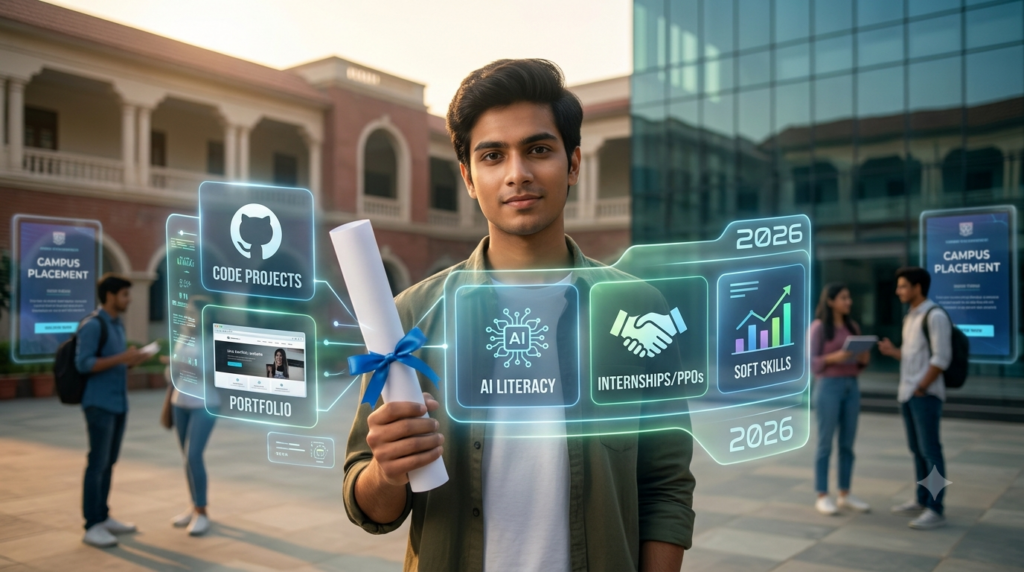
Skills > Degree in 2026: What Recruiters Are Actually Looking For Right Now
Your degree still gets you into the room. It does not get you the offer.
That is the 2026 campus hiring story, minus the LinkedIn slogans.
Companies keep saying they hire on skills. Job descriptions drop the “B.Tech required” line. Then the shortlist arrives and it still looks like last year’s shortlist: known campuses, clean CGPA cut-offs, and a pile of resumes that all list “proficient in Python, Excel, and teamwork.”
If you are in college right now, the useful question is not “Is the degree dead?” It is not. The useful question is: what does a recruiter actually check after they see your college name?
This is that list.
Contents (10)
- The honest version of “skills over degree”
- What recruiters are actually scanning in 2026
- 1. Proof of work, not a list of tools
- 2. Internships — because they are the real interview
- 3. AI literacy that is not “I use ChatGPT”
- 4. Communication that survives a 20-minute call
- 5. Learning speed
- 6. Evidence that you can work with other humans
- The skills that actually move a 2026 offer
- Skills that currently carry a premium
- Skills that get you shortlisted even if you are not from a brand campus
- Skills that look impressive and do almost nothing
- Degree vs skills by path (India, 2026)
- What a recruiter sees in the first 20 seconds
- A semester plan that is more useful than another certificate
- How to talk about your degree without sounding outdated
- Common Gen Z mistakes recruiters mention (quietly)
- FAQ: skills vs degree in 2026
- The one-line version
The honest version of “skills over degree”
Skills-first hiring is real. It is also incomplete.
Globally, a large share of employers now say they use skills-based hiring. Many have removed degree language from at least some roles. Skills also predict job performance better than a transcript does.
On Indian campuses, the picture is more mixed:
- Your college and degree still decide which companies walk onto your campus.
- CGPA still acts as a first filter at a lot of firms. HirePro’s 2026 India college-hiring data found that only about 21% of corporates have fully moved to skills-first hiring, while 51% still let CGPA influence decisions.
- Once you are in the process, recruiters care far more about what you can show than about the name of your paper.
So the slogan “skills > degree” is half right. The working formula for 2026 is:
Degree gets you screened. Skills get you selected. Proof gets you paid.
If you only have the first one, you compete with everyone else in your batch. If you have all three, you stop looking interchangeable.
What recruiters are actually scanning in 2026
Recruiters do not read your life story. They look for risk reduction.
They are asking one question in different costumes: Can this person do the job in three months without becoming a project?
Here is what that looks like in practice.
1. Proof of work, not a list of tools
“Knows Java, SQL, Figma, Canva, ChatGPT” is not a skill. It is a shopping list.
Recruiters notice:
- A GitHub repo with a real README, not a forked tutorial
- A live project link, dashboard, or case write-up
- An internship deliverable you can explain in two minutes
- A portfolio of campaigns, research notes, designs, or analyses
NIIT’s India Skills Gap Report 2026 found that about 45% of employers and candidates now rank portfolios of work among the top signals of job readiness, ahead of several traditional markers.
If you cannot point to a thing you built, shipped, taught, sold, or fixed, your resume is a claim. Claims get filtered.
2. Internships — because they are the real interview
Deloitte India’s Campus Workforce Trends 2026 (257 organisations, 505 campuses) is the report your placement cell is already quoting.
The headline most students missed: internships are becoming the main hiring channel, not a summer checkbox.
- PPO conversion improved by about 6% year on year across degree categories.
- Employers rank behavioural competencies (75%) and learning agility (72%) as the strongest predictors of who gets a PPO — ahead of raw technical scores.
- 86% of organisations say AI or agentic AI is changing how they recruit.
Translation: the two-month internship is no longer “good exposure.” It is a long interview with a stipend. If you treat it like a formality, the company will treat you like one.
3. AI literacy that is not “I use ChatGPT”
AI skills attract a 20–25% campus pay premium in Deloitte’s 2026 data. Analytical thinking and problem-solving sit at 10–15%.
That does not mean you need a research paper in machine learning.
It means you can:
- Use AI tools to draft, analyse, or code — and then check the output
- Explain what the tool got wrong
- Show one project where AI was a part of the workflow, not the whole personality
- Talk about data, not just prompts
HirePro’s 2026 findings add a useful warning: 85% of corporates want students to be Gen-AI-ready, but only 12% treat it as a hard filter. So do not skip everything else to collect AI certificates. Stack AI on top of a real domain skill.
4. Communication that survives a 20-minute call
This one is not trendy. It is still the skill recruiters mention first.
GMAC’s 2026 Corporate Recruiters Survey put communication at the top of current workplace skills, with problem-solving, adaptability, data analysis, strategic thinking and teamwork close behind. AI tools showed the biggest increase in importance — they did not replace the human ones.
On campus, this shows up as:
- Can you explain your project without reading the slide?
- Can you write a clean email?
- Can you disagree without sounding like a group-chat argument?
- Can you follow up after the interview?
Soft skills are not “be nice.” They are “be easy to put in front of a client, a manager, or a cross-functional team.” Several hiring-manager surveys still say they would take a Gen Z candidate with strong people skills over a degree-holder who cannot hold a conversation.
5. Learning speed
Job skills keep moving. The World Economic Forum’s recent Future of Jobs work keeps repeating the same idea: a large share of core skills will change within a few years.
Recruiters test learning agility in small ways:
- How fast did you pick up a tool you were not taught in class?
- What did you do when the internship brief changed?
- Did you update a project after feedback, or freeze it?
A student who learned SQL in three weeks for an internship often looks more hireable than a student who scored 9.2 and has not touched a new tool since third semester.
6. Evidence that you can work with other humans
Teamwork on a resume is wallpaper. Teamwork in 2026 looks like:
- A group project where you can name your part
- A club, fest, NGO, family business, or part-time job with a result attached
- Conflict you handled without disappearing
Campus hiring teams are tired of solo heroes who collapse in a standup.
The skills that actually move a 2026 offer
Not every skill is equal. Recruiters pay for some and ignore others.
Skills that currently carry a premium
- AI development, applied ML, data analysis, cybersecurity, Industry 4.0 tools
- Domain-plus-digital combinations: consumer analytics, digital health, sustainable finance, legal tech, smart-factory skills
- Problem-solving you can walk through out loud
- Clear writing and structured speaking
Skills that get you shortlisted even if you are not from a brand campus
- One deployed or documented project
- One relevant internship with a named outcome
- One certification that maps to the job, not ten random badges
- A LinkedIn profile that matches your resume and shows work, not only banners
Skills that look impressive and do almost nothing
- “Leadership” with no example
- 40 online courses and zero output
- A CGPA flex with no internship
- Prompt-engineering as a personality
Degree vs skills by path (India, 2026)
The answer changes with the door you are walking through.
Campus placements at your college
Degree + CGPA + college brand still open the gate. Skills decide who gets the better role inside the process.
Off-campus product / GCC / startup roles
Portfolio, DSA or domain tests, internships, and referrals beat college rank more often. The degree is background.
PSUs, government exams, core regulated fields
Degree is not optional. Skills help you perform after you clear the paper.
MBA / higher studies after engineering
The degree still buys a pay premium — Deloitte notes MBA campus packages still sit roughly 45–50% above engineering on average, with institute-tier gaps. Skills decide which shortlist you survive.
Do not pick a philosophy. Pick the filter in front of you.
What a recruiter sees in the first 20 seconds
Assume an ATS or an AI screener sees you before a human does. Deloitte reports 72% of surveyed organisations already use AI for resume screening.
That first pass looks for:
- Role keywords that match the JD, not synonyms you invented
- Internships and projects with outcomes (“reduced X”, “built Y used by Z”)
- Dates that make sense
- A skill section that is specific
- No walls of text
Then a human looks for:
- Can I explain this candidate to a hiring manager in one sentence?
- Is there proof, or only adjectives?
- Will this person survive week one?
Write for that human. The AI is just the bouncer.
A semester plan that is more useful than another certificate
You do not need a new personality. You need artefacts.
This month
Pick one target role family: SDE, data, analyst, marketing, operations, design, core, consulting-prep. Write the five skills that appear in real JDs for that role. Ignore the rest.
Next 30 days
Build one proof item. One. A small deployed app, a cleaned dataset + dashboard, a campaign case, a process you improved at a part-time job, a research brief.
Next 60 days
Get that proof in front of people: internship application, cold project for a local business, college consultancy cell, open-source issue, competition with a public write-up.
Every week
Practice explaining the work in 90 seconds: problem, what you did, what changed, what you would do next. Record it. It will feel embarrassing. That is the point.
Do not
Collect 12 badges, rewrite your resume 20 times, and call that preparation.
How to talk about your degree without sounding outdated
Your degree is not the enemy. Treating it as the whole story is.
Better framing:
- “B.Com. Built a monthly MIS for a family retail shop. Cut stock-out errors.”
- “B.Tech ECE. Internship on a test-automation script now used by the QA team.”
- “BA Psychology. Ran a 40-student survey, cleaned the data, presented findings to the faculty.”
College taught you a base. The sentence after the degree is what recruiters remember.
Common Gen Z mistakes recruiters mention (quietly)
- Resume written by a chatbot and never read aloud
- Projects that die the day the submission portal closes
- Internship where the only output was “learned a lot”
- Soft-skill gap that shows up as late replies, no follow-up, or a blank stare when asked “walk me through this”
- Applying to 200 roles with the same PDF
- Assuming a Tier-1 brand will cover a thin profile, or that a Tier-3 brand makes effort pointless
Neither is true. Thin profiles fail everywhere. Specific profiles travel.
FAQ: skills vs degree in 2026
Is a degree still worth it in 2026?
Yes, for most Indian students. It remains the default ticket to campus drives, many government paths, and a large share of formal employers. The degree is not the differentiator anymore. What you attach to it is.
Can I get a good job without a famous college?
Yes, mostly off-campus and in skills-testable roles: software, data, design, digital marketing, operations, some analyst tracks. You need public proof and at least one real work stint. Waiting for the placement cell to save the year is the slow strategy.
Which skill should I learn first?
The one attached to a job you can name. “Learn AI” is not a plan. “Learn enough Python + SQL to clean a dataset and explain it” is a plan. Add AI tools after you have a domain.
Do certifications replace internships?
No. A recognised certificate can help you pass a keyword screen. An internship tells a recruiter you survived a workplace. Prefer the internship. Use a certificate to fill a specific gap.
Will AI take entry-level jobs?
AI is already changing entry-level work and creating new skill requirements — Deloitte found 35% of organisations say AI is creating new entry-level roles or skill needs, up from 21% a year earlier. The students who treat AI as a coworker, not a personality, stay in the process.
The one-line version
In 2026, recruiters are not choosing between skills and degrees. They are choosing between candidates they can verify and candidates they have to believe.
Your college name is a signal. Your CGPA is a filter. Your proof is the offer.
Build something you can send in a link. Then learn to talk about it without flinching.
Campus Reality editorial note: Figures cited from Deloitte India Campus Workforce Trends 2026, HirePro State of College Hiring in India 2026, NIIT India Skills Gap Report 2026, GMAC 2026 Corporate Recruiters Survey, and related public summaries. Hiring practice still varies by company, campus tier, and role. Check the actual JD before you rebuild your entire semester around a trend piece — including this one.
Share this guide
Open now for students
- UCO Bank Apprentice 2026: 530 seats, apply by 29 OctApply nowCloses tomorrowJob · UCO Bank · Last date 29 Oct
- Gujarat GCAS Post-Basic B.Sc. Nursing 2026 admission: apply by 29 OctoberApply nowCloses tomorrowAdmission · Gujarat Common Admission Services (GCAS), Education Departme… · Last date 29 Oct
- IIT Delhi PhD and MS(R) 2026-27: apply by 29 October, 4 pmApply nowCloses tomorrowAdmission · Indian Institute of Technology Delhi · Last date 29 Oct
- Indian Army TGC-145 2026: 30 engineering officer seats (29 Oct, 3 pm)Closes tomorrowJob · Indian Army · Last date 29 Oct